> ## Documentation Index
> Fetch the complete documentation index at: https://jetemail.com/docs/llms.txt
> Use this file to discover all available pages before exploring further.
# Getting Started
> Set up the JetEmail SMTP relay end to end, from signup to your first send.
Pick the path that matches what you're sending from. Each guide takes you all the way through: signup, domain verification, SMTP credentials, server configuration, and a test send.
## What are you setting up?
Use the official JetEmail cPanel plugin to route Exim through the relay.
Use the official JetEmail DirectAdmin plugin for one-command setup.
Configure the JetEmail smarthost in the Enhance control panel.
Generic SMTP setup for any app, CRM, or platform that accepts SMTP credentials.
Configure Postfix as a relay through JetEmail on a Linux mail server.
Configure standalone Exim (no control panel) to use the JetEmail smarthost.
## The universal flow
Every guide above follows the same five stages. If your platform isn't listed, follow this flow and plug the SMTP details into your software's settings.
### 1. Sign up for JetEmail
Create an account at [jetemail.com](https://jetemail.com). Once you're in, the dashboard lives at [dash.jetemail.com](https://dash.jetemail.com).
### 2. Add your sending domain
Each address you send **from** must belong to a domain JetEmail can authenticate.
1. In the dashboard, go to **Outbound** → **Domains**
2. Add the domain you send mail from (e.g. `example.com`)
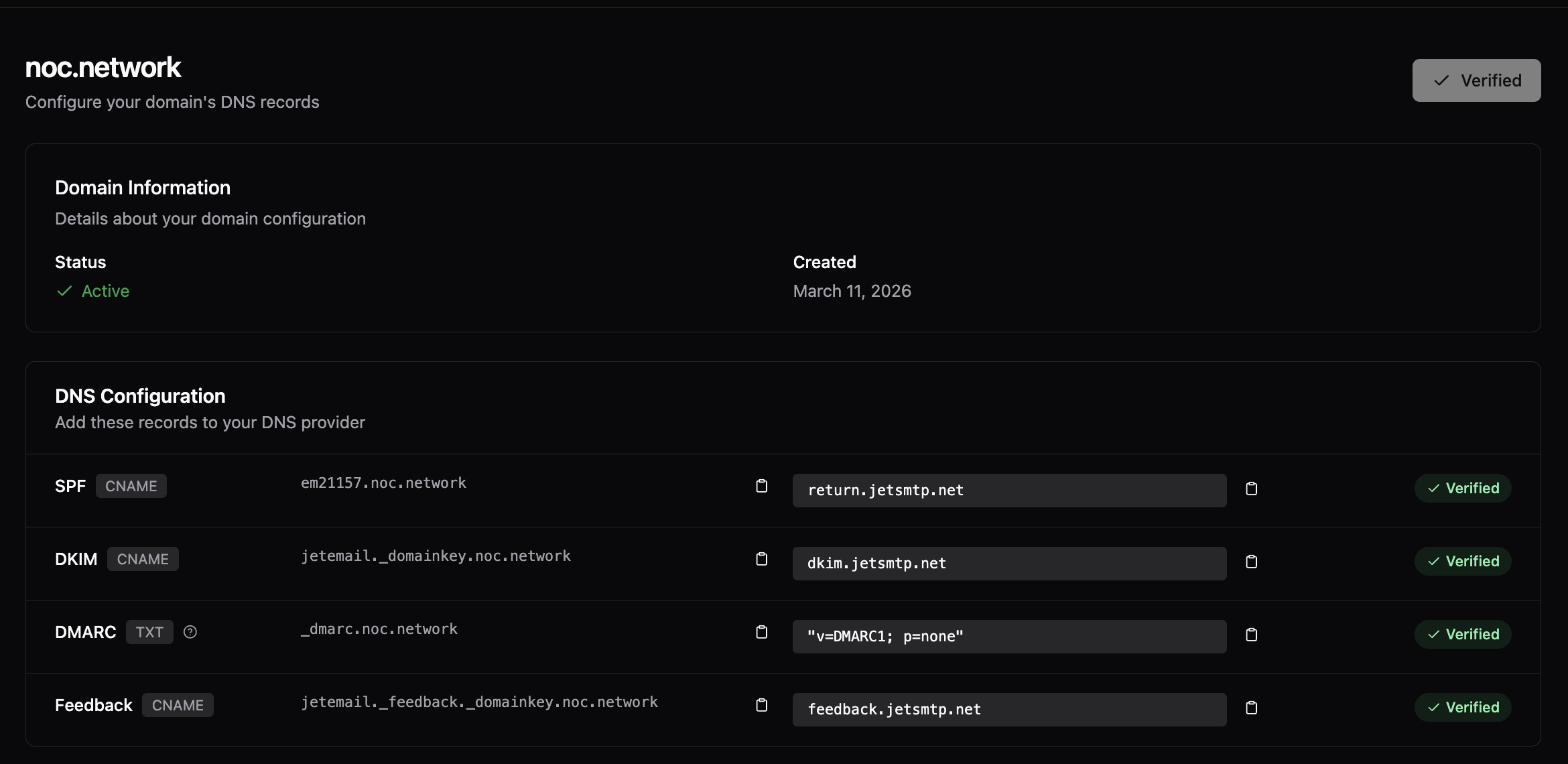
3. Add **every** DNS record the dashboard lists (SPF, return-path, DKIM, DMARC) at your DNS provider
4. Wait until the dashboard shows the domain as **verified**
For a full breakdown of those records, see [Email authentication](/outbound/email-authentication).
**SMTP "allow any domain":** If your account uses SMTP with **allow any domain**, you can send without adding the domain in the dashboard, but you must still publish **SPF** for each sending domain (see [SMTP allow any domain](/outbound/email-authentication#smtp-allow-any-domain)). Adding the domain is still recommended for DKIM signing, aligned return path, and dashboard-only features like open and click tracking.
### Domain validation
A domain counts as **validated** after you add it under **Outbound** → **Domains** and JetEmail verifies your DNS. Validated domains are required for [open tracking](/outbound/open-tracking), [click tracking](/outbound/click-tracking), [BCC copies](/outbound/bcc-emails), and similar dashboard-managed features.
### 3. Create an SMTP user
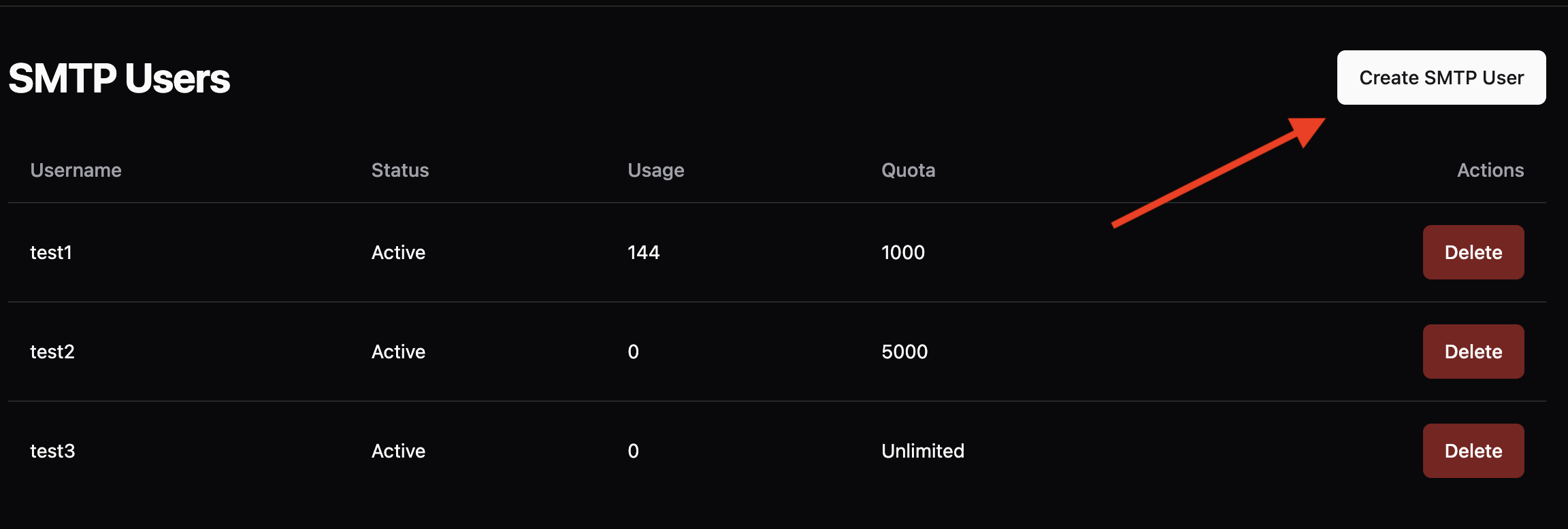
1. In the dashboard, go to **Outbound** → **SMTP**
2. Click **Create SMTP**
3. Fill in the details:
* **Username:** Choose a unique username
* **Password:** Set a strong password
* **Quota / Usage:** `0` for unlimited, or a per-user message limit

### 4. Configure your server or app
Use these values in your mail server, control panel, or application:
| Setting | Value |
| ----------------------- | -------------------------------------------------------------------- |
| **Server** | `relay.jetsmtp.net` |
| **Ports** | **25, 587, 2525** (STARTTLS) · **465** (SSL/TLS) |
| **Authentication** | PLAIN |
| **TLS** | Required on 25, 587, and 2525 (STARTTLS). Implicit on 465 (SSL/TLS). |
| **Username / password** | The SMTP user you created in step 3 |
**EU region endpoint.** If you need an EU-only endpoint, use `relay-eu.jetsmtp.net` with the same settings as above. The global endpoint (`relay.jetsmtp.net`) is the recommended anycast endpoint and gives you the best routing worldwide.
### 5. Send a test message
Send a single message through the relay and confirm it lands. Then check the dashboard's **Logs** view to confirm the send was accepted and authenticated.